Thinking about home EV charger installation but worried your house might not have enough electrical power? You’re not alone. Many homeowners assume they need a major electrical upgrade before they can charge at home.
The good news is that most UK homes can support a modern 7kW smart charger. However, the answer depends on your main fuse, consumer unit, earthing arrangement, existing electricity demand and the route from your electrical panel to the charger.
In this guide, we’ll explain what we check during an electric car charger installation, including 100A supplies, dedicated circuits, PME earthing, PEN fault protection, load balancing and single-phase versus three-phase power.
We’re based in the West Midlands and install chargers across Worcestershire, Warwickshire and the wider UK. So, let’s take the mystery out of the box on the wall and the cables behind it.
How Much Power Does a Home EV Charger Need?
The most common home charger in the UK is a 7kW single-phase unit. In electrical terms, that generally means around 32 amps at 230 volts, producing approximately 7.4kW of maximum charging power.
For comparison, a typical 100A single-phase supply can theoretically deliver around 23kW. A 7kW charger therefore uses roughly one-third of the available supply when charging at full power.
That does not mean your home uses the other two-thirds neatly labelled and waiting for the charger. Your cooker, shower, immersion heater, heat pump, washing machine and kettle may all be using electricity at the same time. This is why we assess the property as a whole rather than simply asking, “Have you got a spare socket?”
A 7kW charger can add around 30 miles of range per hour, depending on the vehicle’s efficiency. For most drivers, that is more than enough to refill the car overnight.
Main Fuse Size: Is 100A Enough?
UK domestic supplies commonly have a 60A, 80A or 100A main fuse. The main fuse is located in the electricity supplier’s cut-out, usually close to the meter. It protects the incoming supply to your home.
A 100A supply is generally a comfortable starting point for one 7kW EV charger, particularly where the existing electrical demand is ordinary. However, a 100A fuse does not automatically guarantee that an installation will proceed without further consideration.
A property with a 60A supply and electric heating, an induction hob and an electric shower may have less spare capacity than a home with a 100A supply and gas central heating. Equally, two EV chargers can create a much larger demand than one.
If the supply is marginal, there are usually two options:
- The Distribution Network Operator may assess whether a fuse upgrade or network work is needed.
- A suitable load-balancing system may allow the charger to adjust its output automatically.
We do not remove or upgrade the main fuse ourselves. Any work involving the service fuse or incoming network supply must be dealt with by the relevant DNO.

Consumer Unit Capacity and the Dedicated Circuit
A home EV charger must be supplied by its own dedicated final circuit from the consumer unit. It should not share a circuit with sockets, lighting or other equipment.
For a standard 7kW charger, that usually means a dedicated 32A radial circuit, protected by an appropriately rated RCBO or equivalent arrangement. The consumer unit must have a suitable spare way, but space alone is not the whole story.
During an EV charger installation, we also check:
- The overall condition and age of the consumer unit.
- Whether the board has suitable RCD or RCBO protection.
- Whether the enclosure and internal wiring are appropriate for the proposed work.
- The available cable route and installation method.
- The expected cable length and voltage drop.
- Whether surge protection or other protective equipment is required.
Cable size is selected for the actual installation. A short, straightforward run may require a different cable arrangement from a long route through a loft, garage or external wall. Bigger is not always better, and guessing from an internet chart is not a substitute for proper design.
The work must comply with BS 7671, the IET Wiring Regulations, including the requirements in Section 722 for electric vehicle charging installations. Domestic electrical work may also fall under Building Regulations Part P requirements.
PME Earthing, PEN Faults and Why They Matter
Many UK homes use a TN-C-S or PME earthing arrangement. In simple terms, the protective earth and neutral are combined in part of the electricity network.
That arrangement is normally perfectly suitable for domestic electrical equipment. EV charging needs additional consideration because the charger is connected to a vehicle outdoors. If the combined Protective Earth and Neutral, known as the PEN conductor, were to fail, the metalwork connected to the charger could potentially rise to a dangerous voltage.
That is why BS 7671 includes specific requirements for EV charging points connected to PME supplies.
Your installer will determine the appropriate protective measure. Depending on the charger and property, this may include:
- Built-in PEN fault detection and automatic disconnection.
- An external PEN fault protection device.
- A separate TT earthing arrangement using an earth electrode.
- Another compliant design permitted by the current wiring regulations.
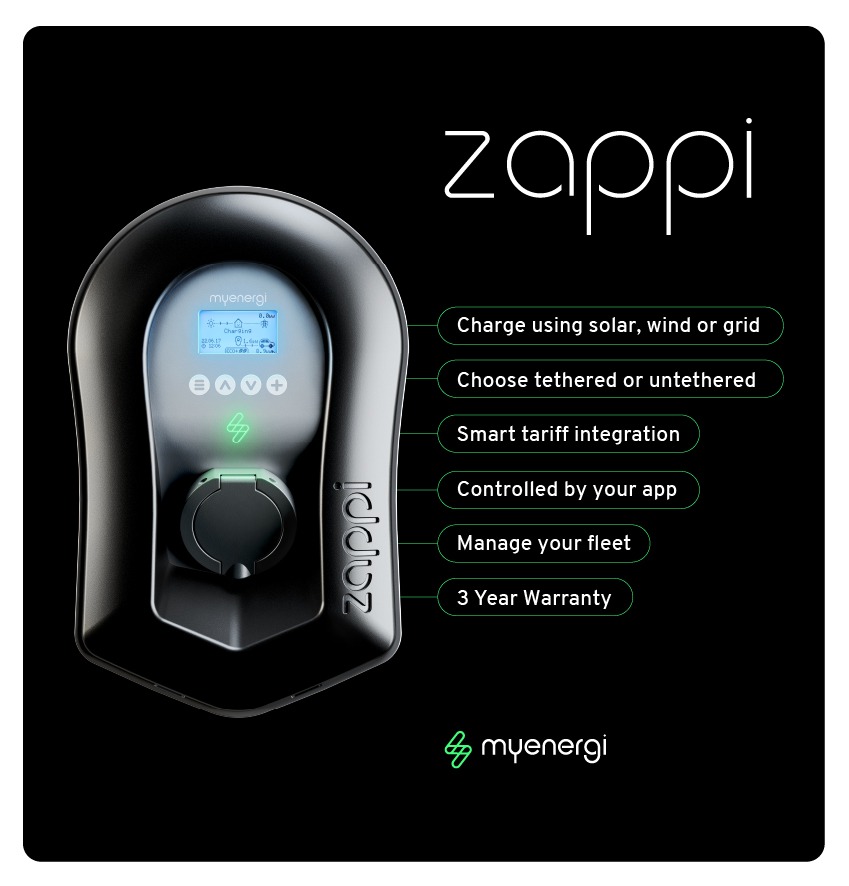
Some chargers, including current versions of the myenergi zappi, include PEN fault technology as part of their design. That does not mean every property has the same installation requirements. The charger, consumer unit, cable route and earthing arrangement must all be considered together.
This is one of the reasons professional installation matters. It is not just a case of attaching a stylish box to the wall and hoping the electrics feel optimistic.
What Is Load Balancing?
Load balancing, also called dynamic load management or home power balancing, monitors the electricity being used by your home. If demand rises, the charger reduces its output or pauses temporarily. When capacity becomes available again, charging resumes.
For example, imagine your home has a 100A supply. Your electric shower, oven and tumble dryer are all running while the car is charging. Rather than allowing the total demand to climb unnecessarily, a load-balancing system can reduce the charger from 32A to a lower current.
When the shower finishes, the charger can increase its output again.
Popular smart chargers approach this in slightly different ways:
| Charger | Load-management approach | Useful features |
|---|---|---|
| Ohme Home Pro | Dynamic smart charging and home power balancing, configured as part of the installation | App scheduling, tariff integration, solar compatibility and up to 7.4kW |
| myenergi zappi | Uses CT clamp monitoring to measure energy flows and manage charging | ECO and ECO+ modes, solar integration and 7kW or 22kW versions |
| EO chargers | Availability depends on the specific model and installation configuration | Smart scheduling and app-based control on compatible models |
The important detail is that load balancing does not create more electricity. It manages the available supply intelligently. Your car may charge more slowly while the rest of the house is busy, but it avoids placing unnecessary strain on the installation.
Smart Charging and Octopus Energy EV Charging
Smart charging is particularly useful if you use a time-of-use electricity tariff. For example, Intelligent Octopus Go can schedule charging for eligible cars and chargers when electricity is expected to be cheaper and often greener.
As of 2026, Octopus states that Intelligent Octopus Go provides up to six hours of smart charging every 24 hours, with discounted whole-home electricity available during the specified overnight window. Exact rates and eligibility can change, so always check the current tariff details before switching.
A compatible charger can also schedule charging through its own app. Ohme, for example, supports energy tariff integration and charging schedules through its app, while zappi offers timed charging and energy-management modes.
The tariff does not alter your home’s electrical capacity. Whether you charge with Octopus Energy EV charging, another supplier or a standard tariff, the charger still needs a correctly designed circuit and suitable protection.
Single-Phase or Three-Phase Supply?
Most UK homes have a single-phase electricity supply. That is normally suitable for a 7kW domestic charger.
Three-phase supplies are more common in commercial premises, larger properties and some newer developments. A three-phase charger can offer up to 22kW, but there are two important catches:
- Your property must actually have a suitable three-phase supply.
- Your vehicle must be able to accept the higher AC charging rate.
Many EVs are limited to 7kW or 11kW AC charging, even when connected to a 22kW charger. Installing a bigger charger does not make the vehicle charge faster than its onboard charger allows.
For most homeowners, a well-installed 7kW charger is the sensible option. For workplaces, multi-car households or commercial premises, three-phase charging may be worth investigating.
What Happens During the Site Survey?
Before we provide a fixed price, we gather the information needed to design the installation properly. Depending on the property and survey method, we may review photographs, plans, meter details and the proposed charger location before an engineer attends.
We look at:
- The main fuse rating and meter position.
- The type and condition of the consumer unit.
- The earthing arrangement, including PME considerations.
- The distance between the consumer unit and charger.
- Internal and external cable routes.
- Wall construction, driveway position and parking arrangements.
- Mobile signal or Wi-Fi requirements for the chosen charger.
- Solar panels, batteries or other large electrical loads.
- Whether load balancing would be beneficial or necessary.
Once we have the relevant details, we provide a fixed-price quote wherever possible. If additional work is genuinely required, we explain why before installation. Our engineers are directly employed, manufacturer-trained and never subcontracted, so you get practical advice without the hard sell.
We can often install a charger within as little as five days after you receive and accept a fixed-price quote, subject to availability and any DNO requirements.

Does Your Home Have Enough Power?
For many homes, the answer is yes. A standard 100A single-phase supply, a suitable consumer unit and a straightforward cable route will usually support a 7kW home charger.
But the only reliable way to know is to assess the complete installation. A smaller main fuse may still work with dynamic load balancing, while an apparently generous supply could need attention if the consumer unit or earthing arrangement is unsuitable.
If you are considering an electric car charger installation in Worcestershire, Warwickshire, the West Midlands or elsewhere in the UK, contact EV Power Point for honest guidance and a fixed-price quote. We fit all major charger brands, including Ohme, Andersen, Ratio, EO and myenergi zappi.
If spreading the cost would help, you can also read our guide to EV charger finance options. The aim is simple: a safe, tidy installation that works with your home, your car and the way you use electricity.